
Stamp Catalog
Keep a private catalogue of your stamp collection in the browser. Record each stamp with its catalogue number, condition and value, filter by country or year, see totals, and export a checklist or spreadsheet.
- Free to use
- No sign-up
- Runs in your browser
Your stamp catalogue
Entries are kept in this browser's local storage on this device only. Export a CSV regularly as a backup.
Stamp Collection Inventory Kit
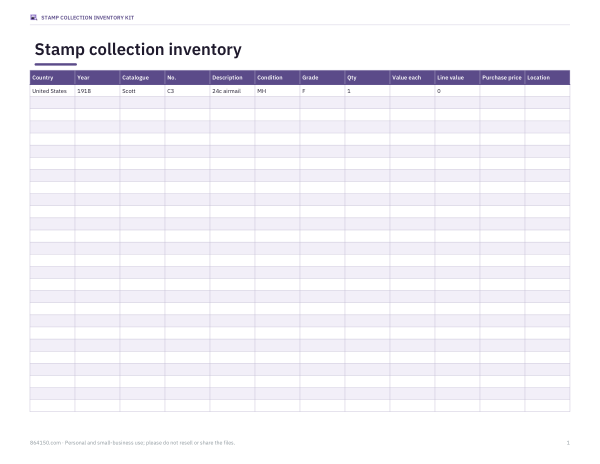
A spreadsheet inventory with country summaries and printable album pages and want lists for collectors.
- Collection inventory workbook (XLSX)
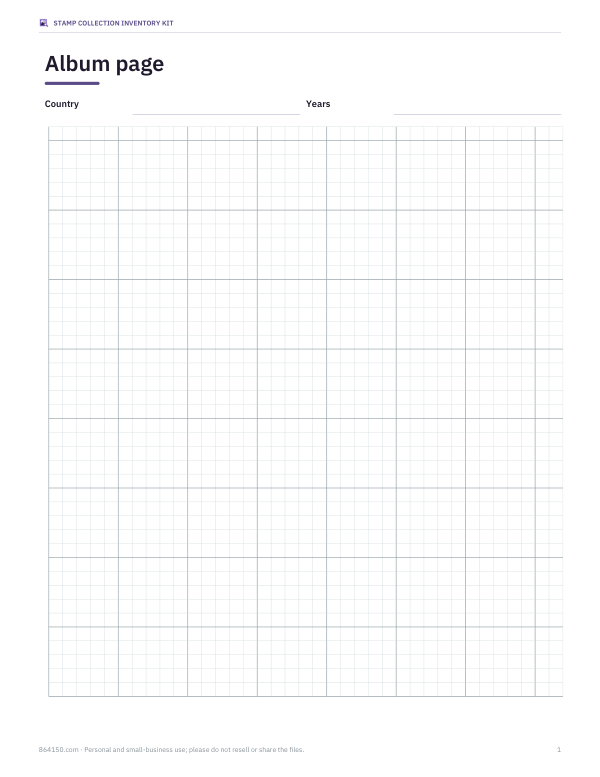
- Blank album & quadrille pages (PDF, DOCX)
Formats: XLSX, PDF, DOCX. Instant download after payment (link valid 72 hours, up to 5 downloads). AI-assisted: the templates were drafted with AI help and reviewed and laid out before publishing.
$5.00 USD, one-time
- Instant download
- 7-day refund
- Secure checkout by Stripe
7-day money-back guarantee. Full refund within 7 days of purchase, even after you download.
Full refund within 7 days — see the refund policy and license.
Free printables
Single sheets you can print right now, no sign-up. The full pack adds every sheet in one download plus the editable files.
What a stamp catalogue is
A stamp catalogue is a reference book that lists every stamp issued by a country or region, gives each one a unique catalogue number, describes its design, denomination, perforation and watermark varieties, and quotes a catalogue value for mint and used copies. Collectors use catalogue numbers to identify stamps precisely, to organise albums and to communicate with dealers — “US Scott C3” means one specific stamp, the 1918 24-cent airmail, anywhere in the world.
This tool is your own catalogue of the stamps you actually own. It does not reproduce any published catalogue's data; you enter the numbers and values from the catalogue you use, and the tool keeps them organised, totals them and exports them.
The major catalogue systems
| Catalogue | Origin | Typical use |
|---|---|---|
| Scott | United States | Standard numbering in North America; worldwide coverage in annual volumes, plus a detailed US specialised catalogue |
| Stanley Gibbons (SG) | United Kingdom | Standard in Britain and the Commonwealth; country volumes and the “Stamps of the World” series |
| Michel | Germany | Widely used in German-speaking countries and for European and topical collecting |
| Yvert et Tellier | France | Standard in France and French-speaking countries |
| Sakura | Japan | Standard for Japanese stamps |
Numbers are not interchangeable between systems: the same stamp has a different number in Scott, SG and Michel. Record which catalogue a number comes from, as the form above does, and use one system consistently for each country in your collection.
Recording condition and grade
Catalogue values are quoted for a particular condition, so recording condition matters as much as the number. Two things are usually described: the state of the gum or cancellation, and the grade, which mainly reflects centring and faults.
- MNH — mint never hinged: unused with original gum and no hinge mark.
- MH — mint hinged: unused, but the gum shows a hinge mark or remnant.
- Mint no gum — unused stamp without its gum.
- Used — postally used with a cancellation.
- CTO — cancelled to order, cancelled by the post office without postal use, common on some modern issues.
- Grades — XF (extremely fine), VF (very fine), F (fine), VG (very good). Scott values generally assume very fine condition; better-centred stamps can sell above catalogue, and faulty ones well below it.
Catalogue value is not market value
A catalogue value is a reference price, not a guaranteed selling price. Common stamps often trade for a small fraction of catalogue value, and many catalogues set a minimum value for the cheapest stamps that mainly reflects a dealer's cost of handling them. Scarce stamps in top condition can sell above catalogue. Use the total in this tool to track your collection and its insurance value, and look at recent dealer and auction prices before buying or selling anything valuable.
A simple workflow for cataloguing a collection
- Sort stamps by country, then roughly by date.
- Identify each stamp in your catalogue: design, denomination, colour, then perforation and watermark if the catalogue lists varieties.
- Enter the country, year, catalogue number and description.
- Record condition and grade honestly — it prevents disappointment when you sell.
- Enter the catalogue value for that condition from the edition you use, and note the edition year in the description if values matter to you.
- Export a CSV after each session so you have a backup.
The filter box searches every column, so you can quickly answer “which Canada stamps from the 1950s do I have?” before a stamp show, or print a checklist of numbers to carry to a dealer.
Organising by country, topic or both
Most collectors start with a country collection, following the catalogue order so that gaps are easy to spot. Others collect by topic — birds, ships, space, sport — which crosses national boundaries and makes catalogue numbers even more important, because a topical album mixes stamps from many countries. You can do both in this tool: put the country in the country field and the topic in the description, then filter by either. Many collectors also keep a separate list of duplicates for swapping; set the quantity above one, or add a word such as “swap” to the description so the filter can find them before a club meeting.
Identification tools worth owning
Catalogue numbers often depend on small details. A perforation gauge measures the number of perforation holes in 2 centimetres, which separates otherwise identical stamps. A watermark detector tray and fluid, or simply a black background, reveals watermarks. A 10× magnifier helps with plate flaws and printing methods, and stamp tongs protect gum and paper. Good lighting and an ultraviolet lamp help with tagging and paper differences on modern issues.
Importing and exporting
The CSV export opens in Excel, Google Sheets or LibreOffice, and uses the same columns as the table. To import an existing list, save your spreadsheet as CSV with the columns in the order shown in the table — country, year, catalogue, number, description, condition, grade, quantity, value — and a header row. Imported rows are added to what is already stored.
Frequently asked questions
Does this tool include catalogue values?
No. Published catalogue data is copyrighted and changes every edition. You enter values from your own catalogue, and the tool totals them.
Where are my stamps stored?
In this browser's local storage on this device. Nothing is uploaded. Export a CSV to back up or move your catalogue.
Which catalogue should I use?
The one used in your region or by the dealers you buy from: Scott in North America, Stanley Gibbons in the UK and Commonwealth, Michel in Germany, Yvert in France.
Why is my stamp worth less than catalogue value?
Catalogue values assume a specific condition and are reference figures; market prices for common stamps are usually much lower.
Can I track covers and postcards?
Yes, choose “On cover” as the condition and describe the cover in the description field.